

commentary
authored by
Obviously, it is impossible to give much insight into Irish history in this commentary, and I will ask Irish history buffs to allow me a little poetic license as I breeze through 400 years of history in but a few lines.
Obviously, it is impossible to give much insight into Irish history in this commentary, and I will ask Irish history buffs to allow me a little poetic license as I breeze through 400 years of history in but a few lines.
From about 1200 to 1600, Ireland consisted of numerous independent kingdoms. Some of those kingdoms were formidable enough to seek assistance and alliances from abroad. As a matter of fact, the initial ‘English invasion’ of Ireland was at the invitation of an Irish king in need of military support. This invasion might be better thought of as an English infection of Ireland. The historical impression of a superior, armed, and manned England beating down on a ‘poor, impoverished’ Ireland is simply not accurate during this early period. The English were always inferior when measured against a potential alliance of Irish kingdoms. A single Irish kingdom could not be defeated without the willing alliances of neighbouring rivals.
To English military adventurers, Ireland was a rich bounty—a land covered in forestry, fertile ground, and livestock. They had a free license from their king to exploit and conquer as best they could. It took 400 years of advances and setbacks to turn this aspiration into reality. As the invading nation, the English enjoyed a unity of purpose, consistency, and freedom from constraint. Ireland was not a defending nation; it was a collection of competing kingdoms with fluid or contingent objectives. These objectives were always shaped by the fact that they were defending home ground. They were preoccupied with rival factions within their own kingdoms and competing kingdoms bordering their territory. The English were yet another headache!
Military adventurers do not have to worry as much about defence in foreign lands. The location of a war really matters. Atrocities performed in foreign lands cannot be avenged on an eye-for-an-eye basis. Irish kingdoms could not travel across the sea to sack, burn, and slaughter the inhabitants of Windsor Castle. Unburdened by defensive concerns, military expeditionary commanders have a wider range of options. Moral or ethical concerns are but a bump in the road when the stated mission is to steal as much as you can, far from home.
Spying, bribing, kidnapping, truce-breaking, daring attacks, genocidal campaigns, temporary alliances, and self-aggrandizing propaganda are all part of the mix for an invader. But it is the unity of purpose and consistency over generations that ensures final victory. The host territory, as a mixture of rivalries and competing factions, is generally unable to match the single overarching strategy of the invader.
Irish history is not a story of good guys and bad guys; it is just history. But we may be able to glean some lessons about the American ‘project’ in the Middle East and the constraints on the various nations in that region. We may be able to view the hand that each party to the conflicts has been dealt.
There are broadly two sides in this multi-generational conflict. First, we have the region’s host nations—the defenders. Second, we have the expeditionary nations of America, its NATO allies, and, of course, Israel. The Jewish state has had numerous military skirmishes since its foundation with as many as a dozen countries in the region. This loose Western alliance is led by the United States and can be described as the attackers. In this analysis, I will write mostly about Iran and the USA, the chief protagonists in the present round of conflict.
The Oil Nations of the Middle East
I invite the reader to take a glance at the map below and guess how many countries share either land or maritime borders with Iran.
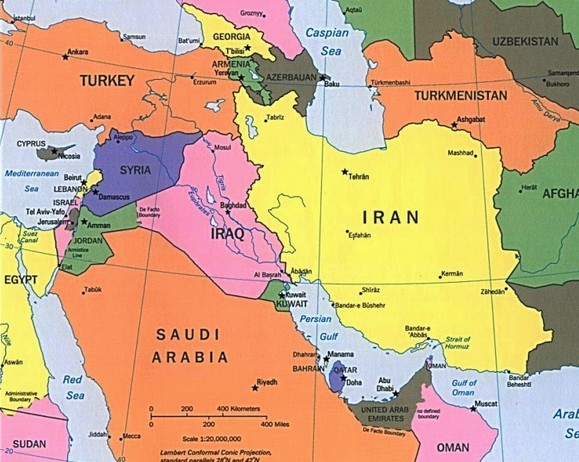
The answer is 13 (seven land borders and six maritime borders). At a push, we could bring this total to 15 if we include Russia and Kazakhstan via the Caspian Sea. All of these neighbouring countries have the potential to be rivals or allies. Furthermore, within Iran itself there are about 5–7 sizable ethnic minorities that make up about one third of the population. The whole Middle East region is a vast patchwork of rival principalities and states, many of which contain important ethnic minorities with different languages, religions, and customs. Not unlike the Gaelic kingdoms of medieval Ireland, the Iranians have a lot to contend with before they even consider the American Middle East strategy.
The American Project
The Middle East may be a complicated place for its inhabitants, but not so forthe Americans and their NATO allies. When they look at the map of the MiddleEast, this is what they see:[The green areas are oil fields and the red areasare gas fields.]
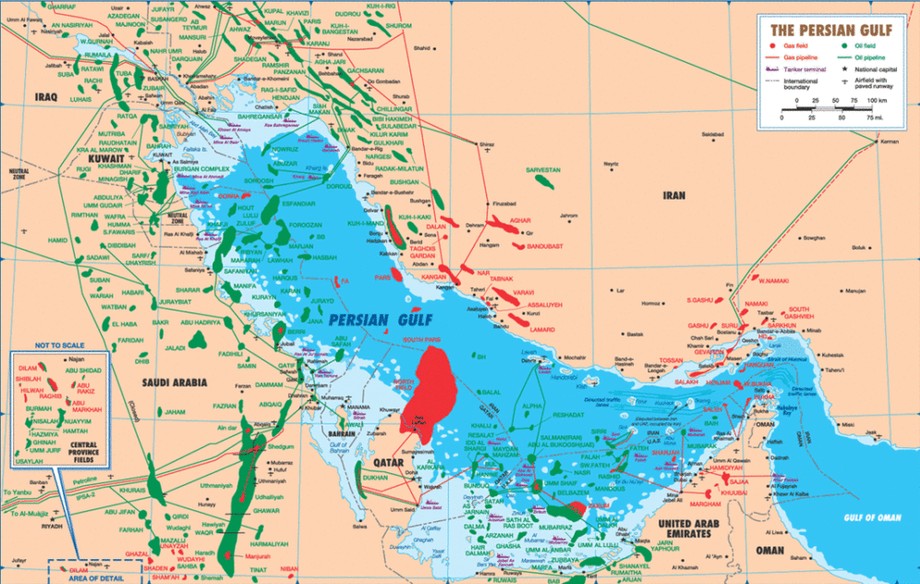
As the medieval English saw an Emerald Isle of milk and honey, so the Americans and NATO see a veritable underground ocean of fossil fuels.
The array of military garrisons throughout the Middle Eastin some way reflects the focus the U.S. has on the profits generated from fossil fuels.
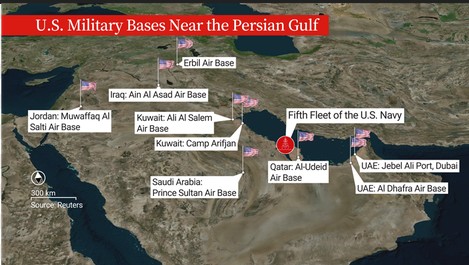
The USA and NATO are not overly concerned with how the various political entities in the region are run. Excluding Israel, they have no particular desire to colonize the region. They are not trying to spread democracy or the American way. Their focus on fossil fuels is incredibly refined: they don’t need to own it, but they do need to control the wealth emanating from it. They want the fuels pumped and shipped in an orderly fashion, at a profit, and on dollar payment rails. Furthermore, they want excess savings lent to the U.S. government, and investment and procurement contracts directed to Western contractors. It doesn’t matter whose name is on the title deeds of Middle Eastern oil. What matters are the profits. They must be spent on Western goods and services, with the remainder parked in Western financial assets.
This is the single, laser-like focus of America. In the pursuit of this, they will spy, bribe, blackmail, fund and arm separatist rebel groups, treat with tiny kingdoms, pledge and break allegiances, steal financial assets, sanction people, groups, and countries, bomb, kill, and maim both military and civilian targets. All of this is done under the usual blather of self-aggrandizing propaganda.
The greatest strengths of America’s grand strategy in the Middle East are consistency and resilience. They have maintained a continuous press on the region and taken occasional setbacks in their stride. For example, at present it can be said that Iran has been at war on and off for much of this year. However, the same cannot be said of the USA. An American citizen could be forgiven for not realizing that their country was in a war. There are no bombs dropping in New Jersey or Nevada. Life in the U.S. today is not much different from life last year. America’s lost military assets in the latest round of this conflict will be replaced in time.
America’s ongoing campaign to maintain pressure on Iran (and indeed Russia) is almost effortless. On the other side, Iran is straining to survive. Its citizens most certainly know that they are at war as the death toll climbs and the economy shrinks. There is an elegance to America’s energy strategy in the region. The local political entities can make all the profits they wish, but the profits must be in dollars and subsequently those same profits must be spent and/or invested in the West. It is that simple.
Iran’s Evolving Strategy
Iran has worked to stay outside of the American (NATO) orbit. It seeks to create a sphere of influence itself in the region. For Iran to succeed in this endeavour, it would need to permanently eject the American garrisons from the Persian Gulf. I would suggest that this is extremely unlikely.
They have had some minor successes in the past by using and supporting proxies to attack American allies in the region. But these were little more than fleeting tactical wins. It appears as though the fortunes of Hezbollah and Hamas have suffered a severe reverse. The Houthis may prove to be a little more effective. Overall, these proxies have been little more than a minor irritant to their foes.
In this latest bout, Iran has had some assistance (usually clandestine) from important military powers from outside the region, most notably Russia and probably China. This assistance, when given, is very contingent on Russia or China’s relationship with the West. While China and Russia may be happy to make things a little more difficult for the U.S., their commitment to Iran may be a secondary consideration.
For Iran to succeed, it will need the littoral nations of the Persian Gulf to coalesce militarily and politically to oust the Americans. It would need to convince Arab nations (particularly the Saudis) that they will have a better future if they control the profits from fossil fuels themselves. This is a tall order, but not impossible. In 2022, the American alliance ‘froze’ (stole) $300 billion of Russian assets trapped in the U.S. dollar system. This theft sent a chill down the spine of the most ardent ‘pro-American’ Arabian statesmen. So there are positive arguments to be made for the Persian Gulf states breaking away from the West. However, in my view these arguments would not be enough; some coercion would be required. And it is possible that, to some extent at least, we are seeing that now in Iran’s willingness to hit targets in neighbouring countries.
Further Lessons From Irish History
England finally gained full control over Ireland around 1600, culminating in the Nine Years’ War (1594–1603). Two major Irish kingdoms united and formed a wider confederation of kingdoms to finally expel the English from Ireland. They received some help from the Spanish in this endeavour. They had a track record of repeated wins against the English over seven years and were expected to inflict a final decisive defeat on the English in the Battle of Kinsale in 1601. Nevertheless, battles can have a life of their own. The English were victorious. The Irish confederacy broke apart almost immediately. The small Spanish contingent surrendered to the English. England was saved. For if they had lost, the Spanish would have built on the victory, sent reinforcements, and possibly attacked England from the Irish coast. Remember, this was only 13 years after their failed Armada.
Lesson 1
Confederations are hard to build. The Irish shared a common language and religion. They even operated under a shared legal system (Brehon Law). But they could not hold it together. It would be very difficult for a confederation to form and hold together in the Persian Gulf. They have different languages, religions, legal systems, and ethnicities.
Lesson 2
The English crown was bust after the Nine Years’ War in Ireland. They emptied their treasury and lost between 20,000 to 70,000 men, depending on whose propaganda you prefer to believe. From an Elizabethan English population of approximately 4.2 million, this compares with their losses in World War One or World War Two. Why did they fight so hard? The English could not contemplate an independent and vengeful Ireland hosting another massive Spanish Armada. This war became existential to them—a war of survival.
The American alliance can easily keep a firm grip on the Middle East. Up to this point, it hasn’t required too much effort. An ejection from the Persian Gulf would mean that the profits from oil and gas could be booked in other currencies like the ruble or the yuan. The spending and investing of those profits could be directed away from the West. This would be a catastrophe for the dollar and would severely limit U.S. international power. The point is that the American alliance will go to any length to ensure this doesn’t happen.
In my view, the salient point is that whereas the American-led alliance can afford to lose in Ukraine, they cannot afford a loss in the Middle East. The use of the dollar is of paramount importance to America. If Iran ups the ante, the USA will keep responding in kind. America will not walk away from the Persian Gulf in the near term unless they are militarily defeated. Like the medieval English before them, they cannot afford to lose this one.
Concluding Remarks
The longer this war goes on, the less important the Strait of Hormuz will become for the oil price. The oil producers will find a way to get their oil to market either through alternative routes or by increasing production elsewhere. However, the political importance of Hormuz will not fade away. The longer Iran maintains effective control over it, the weaker U.S. influence becomes in the region. This is an intolerable state of affairs for the American alliance.
Given that control of the straits is non-negotiable for both sides, this dispute will only be resolved by force. Sadly, it looks like we maybe in for a long war of growing intensity.
There is no shortage of fossil fuels in the world. The oil industry is already recalibrating refineries, pipelines and shipping routes to cope with the disruptions in Hormuz and the Red Sea. Nevertheless, the chances of a major spike in oil prices in the next 12 months are high.
